CAT TREE GUIDE
Cat Trees for Small Spaces: How to Choose a Compact Tree That Still Works for Your Cat

Measure the Whole Tree, Not Just the Base
When floor space is tight, it is tempting to shop by one number: base width.
That is useful, but incomplete.
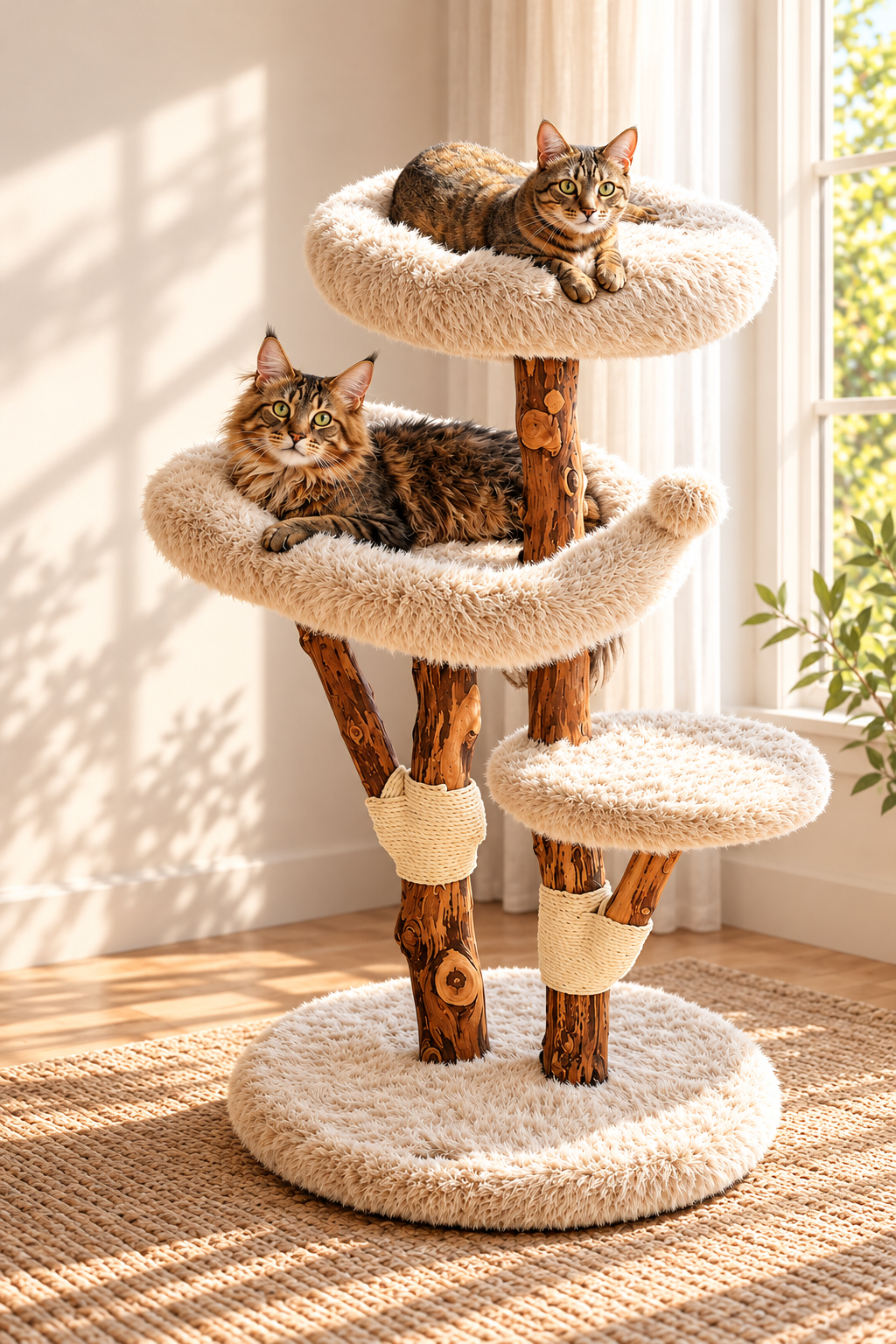
A cat tree can have a compact base and still project into the room through a wide perch, hammock, basket or upper platform. The opposite can also happen: a tree that looks large in a product photo may fit neatly into a real corner because its usable width is concentrated vertically.
For a small apartment, measure five things:
- Floor footprint — the base width and depth.
- Full furniture envelope — the widest point anywhere on the tree, not just at the floor.
- Human circulation — door swing, walking path, chair pull-out space and access to cabinets.
- Cat circulation — where your cat gets on, turns, stretches, jumps off and leaves.
- Usable cat space — whether the perch, bed and scratch surface still fit your individual cat.
A cat tree that fits your room perfectly but gives your cat nowhere comfortable to rest or stretch is not actually space-efficient. It is just small.
Current FelineVMA guidance says indoor-cat environments should support natural feline behavior, and its indoor/outdoor guidance explicitly includes safe territory with vertical space among essential resources. The goal, then, is not to buy the smallest object you can find. It is to create useful territory without making the room harder to live in.
If you are still comparing cat trees more broadly, start with the Cat Tree Buying Guide.
Start With a Real Rectangle on Your Floor
Before opening another product tab, choose the exact place where the cat tree could live.
Then measure the space as a rectangle. Do not measure the whole room. Measure the actual patch of floor you are willing to give to cat furniture.
A simple method is to use painter's tape or objects already in the room to mark the proposed width and depth. Then live around that rectangle for a few minutes.
Ask:
- Can the door still open fully?
- Can you walk past without turning sideways?
- Can a desk chair pull out?
- Can you reach the window, closet or cabinet?
- Will a curtain or blind hang into the structure?
- Is the tree crowding a heater, vent or other household feature?
- Is there somewhere sensible for the cat to approach and leave?
This catches a common shopping mistake: a base may technically “fit” while the furniture around it stops working.
The best empty corner is not always the best cat corner
A corner can be useful because it often consumes space that was not doing much else. But do not force the tree into a forgotten corner simply because the floor is empty.
Ohio State's Indoor Pet Initiative recommends giving indoor cats perches near windows so they can look outside. That does not mean every cat tree must sit at a window, but it is a good reminder that placement affects how useful the furniture is.
A slightly less compact location that gives your cat a view or connects to an existing route may be more valuable than the smallest possible corner behind a door.
Measure the Full Furniture Envelope
Product pages often make one dimension feel more important than it is. For a small-space decision, think of the tree as a three-dimensional envelope.
Measure the base
Start with the manufacturer's width and depth. That tells you how much floor is permanently occupied.
Then find the widest point above the base
Look for side baskets, hammocks, oversized top beds, platforms that extend past the base, and toys or scratch boards that project sideways.
This is the overhang. If the base is 18 inches wide but the upper perch reaches 25 inches into the room, you need room for the 25-inch envelope.
Check the route around the tree
A product can fit the wall and still block the room. Pay special attention to narrow hall-like areas, the path between sofa and coffee table, the path from bed to door, kitchen or closet access, sliding doors and furniture that moves during normal use.
There is no universal “correct” walkway number for a cat tree. Your room, furniture and household are different. The practical test is whether normal daily movement still works after the full tree—not just its base—is represented in the space.
Check the route through the tree
Now switch perspective. Where does your cat put the first paw? Where is the next landing? Can your cat turn on the platform? Is the top bed easy to enter and leave? Does one large perch block the route to another level?
A compact design works best when the vertical space is actually usable, not when the manufacturer simply stacks more features into a smaller rectangle.
Make Sure “Compact” Still Fits the Cat
Small-space shopping can create a bad trade: the room gets more space, but the cat gets less. That is why a small-apartment guide still needs a cat-size check.
Resting surfaces
Look at the usable surface of the top perch or bed, not the outside dimension of a decorative rim.
Your cat should be able to settle in the position they normally choose. If you have a larger-bodied cat, continue with the Cat Tree Size Guide before deciding that a compact model is a fit.
Scratching height
Ohio State's scratching guidance recommends vertical scratching posts that are high enough for the cat to stretch and sturdy enough not to fall over during use.
Do not shrink the scratching job until it stops working.
If the compact tree has only a short scratch zone, it may be smarter to add a separate vertical scratcher than to force one tiny product to do everything.
Climbing route
Not every cat wants maximum height. In owner discussions, some cats are described as heavy climbers while others prefer window platforms or lower routes. That is owner experience, not a universal behavior rule—but it is a useful reminder to observe the cat in front of you.
If your cat already prefers the back of the sofa, a windowsill, a low shelf, or the top of a cabinet reached in steps, use that behavior as a clue when choosing the structure.
Four Placement Patterns That Work in Small Homes
There is no single best placement. Each pattern solves a different room problem.
Pattern A: The corner
Useful when: you have a genuinely unused corner and want the tree to feel visually contained.
Check the full upper-platform projection, access from at least one practical side, nearby curtains or blinds, and whether the cat can leave without jumping into furniture.
A corner is a space-saving location. It is not automatically a structural stabilizer. Stability still depends on the tree, assembly, floor and any manufacturer-required anti-tip method.
Pattern B: The window zone
Useful when: your cat likes observation and the tree can sit near a window without blocking the room.
Ohio State specifically recommends window-adjacent perches as one way to make indoor environments more interesting.
Check blind cords, curtain interference, secure windows/screens, whether the top perch lines up with a useful view, and whether the tree blocks a heater or vent.
Pattern C: Beside the sofa or desk
Useful when: existing furniture can become part of the route.
A compact tree does not have to be an isolated tower. It can work as one step in a larger vertical system: floor → tree → sofa back → windowsill or another safe higher surface.
Make sure the furniture itself is suitable for that use and that the route does not encourage unsafe jumps onto fragile objects.
Pattern D: The quiet wall zone
Useful when: windows are limited or the room is busy.
A calm wall can still work if the tree gives the cat a comfortable resting position, usable scratching and a clear route. You can add enrichment separately through play, toys, food puzzles or another perch rather than expecting the cat tree to provide every experience.
“Zero Floor Space” Is Not the Same as “Zero Installation”
Wall systems and floor-to-ceiling tension trees appear constantly in small-apartment recommendations. They can be useful, but the renter question is more complicated than “does it save floor space?”
Freestanding tree
Pros: no wall installation, easy to understand and relocate, available in many heights and footprints.
Trade-off: needs a base appropriate to the design and still requires full overhang and traffic-path measurement.
Floor-to-ceiling tension system
Pros: can use vertical height with a narrow floor area and may work where a wide freestanding base does not.
Trade-off: ceiling height and construction matter; installation and re-tightening requirements vary; some products still include or recommend an anti-tip strap; “tension mounted” does not mean “guaranteed damage-free.”
Follow the product's installation instructions and check whether the ceiling/wall conditions in your home are compatible.
Wall-mounted shelves or climbing furniture
Pros: can preserve floor area and create a custom route.
Trade-off: wall construction and anchors matter; leases and landlord rules vary; it is an installation project, not simply a furniture purchase.
If you are not certain about the wall, hardware or lease, a freestanding solution is easier to evaluate without making assumptions.
One Object Does Not Have to Do Every Job
A useful small-space setup can be a system, not one giant multi-function tower.
| Job | Possible solution |
|---|---|
| Elevated resting | Compact tree, window perch, safe furniture route |
| Scratching | Tree scratch surface or separate vertical scratcher |
| Hiding | Condo, box or other appropriate retreat |
| Play / enrichment | Interactive play, toys, food puzzles, observation zone |
This is especially useful when a single compact tree forces too many compromises.
For example, a small freestanding cat tree may give you the resting and climbing area you want, while a separate scratching post gives your cat a better full-body stretch.
That can be more functional than buying a wider “all-in-one” tower simply because it includes every feature on one base.
Compare the Shape of the Footprint, Not Just the Number
Compact cat furniture can use the same amount of floor area in very different ways. Measure width, depth and the widest upper overhang, then compare that complete envelope with the actual shape of your available space.
Square compact footprint
A roughly square base can work well in a corner or beside a window when both room dimensions are limited. Still check whether upper perches or hammocks extend beyond the base and whether the main resting area is large enough for your cat.
Rectangular footprint
A longer, narrower tree can fit better beside a sofa, wall or cabinet even when its total floor area is not the smallest. This is why comparing only the narrowest dimension can be misleading.
Split the jobs when one compact tree cannot do everything
If a compact tree gives your cat a useful perch but only a small scratching area, a separate scratcher can sometimes solve the scratching job with less floor-space pressure than buying a second full tree.
Small-space fit is a shape problem, a route problem and a cat-use problem—not just a smallest-footprint contest.
Save This Small-Space Measurement Checklist
Room fit
- □ I measured the exact placement area, not the whole room.
- □ I checked both base width and base depth.
- □ I checked the widest upper perch / basket / hammock projection.
- □ The door can open normally.
- □ The main walking route still works.
- □ The tree does not conflict with curtains, blinds, vents or moving furniture.
Cat fit
- □ The main resting surface fits my cat's normal resting posture.
- □ The scratching surface is useful for my cat's stretch, or I have a separate scratcher.
- □ The route between levels makes sense for my cat.
- □ The cat has a practical way to enter and leave the structure.
Home / renter fit
- □ I know whether the product is freestanding, tension-mounted or wall-mounted.
- □ I checked the manufacturer's installation instructions.
- □ I checked wall/ceiling compatibility when installation is required.
- □ I am not assuming a “renter-friendly” label means damage-free.
Buying fit
- □ I compared the tree by dimensions and functions, not just the word “compact.”
- □ I checked current product dimensions on the listing before ordering.
- □ I know which job this product is solving: rest, climb, scratch, hide—or several.
Common Questions About Cat Trees for Small Spaces
What size cat tree is best for a small apartment?
There is no universal apartment-cat-tree footprint standard. Start with the exact space you are willing to give the furniture, then compare the tree's base, widest overhang, height, cat route and human circulation. A 45 × 45 cm tree may fit one studio beautifully and block another apartment's only walkway.
Is a shorter cat tree always better for a small room?
No. A shorter tree can still have a wide base, while a taller design can sometimes use a relatively narrow floor area. More importantly, your cat may prefer a certain perch height or route. Choose based on the room and the cat, not height alone.
Do cats need vertical space in apartments?
FelineVMA’s current indoor-cat guidance emphasizes meeting natural behavioral needs, while its indoor/outdoor guidance explicitly includes safe territory with vertical space among essential resources. A cat tree is one way to provide it, but shelves, perches and safe existing furniture routes can also contribute.
Should I put a cat tree next to a window?
A window-adjacent perch can give a cat an observation point, and Ohio State includes window perches in its indoor-environment recommendations. Use the window location when it also works for your room and does not introduce conflicts with blinds, curtains, vents or unsafe access.
Can a scratching post replace a cat tree?
It can replace the scratching function, not necessarily the resting and climbing functions. In a small home, separating those jobs can be smart: one compact tree plus one good scratching post may fit better than one oversized all-in-one tower.
Are floor-to-ceiling cat trees good for renters?
They can be useful where floor space is limited, but do not assume every tension system is damage-free or compatible with every ceiling. Check the exact product instructions, ceiling conditions, any anti-tip requirements and your lease.
The Small-Space Rule Worth Remembering
Do not ask: “What is the smallest cat tree I can buy?”
Ask: “What is the smallest setup that still gives my cat useful territory and still lets my home work normally?”
That change in question prevents most of the bad compromises.
Measure the whole tree. Measure the room around it. Measure the parts your cat actually uses.
Then choose the format that fits both lives.
Explore current Cat Trees for Small Spaces, or use the Cat Tree Size Guide if your next question is whether the perch and resting areas fit your individual cat.
Sources and Evidence
Use feline environmental-needs guidance for behavior and welfare questions, product specifications for dimensions, and owner reports for practical apartment concerns. Do not treat anecdotal owner experience as an engineering or welfare standard.