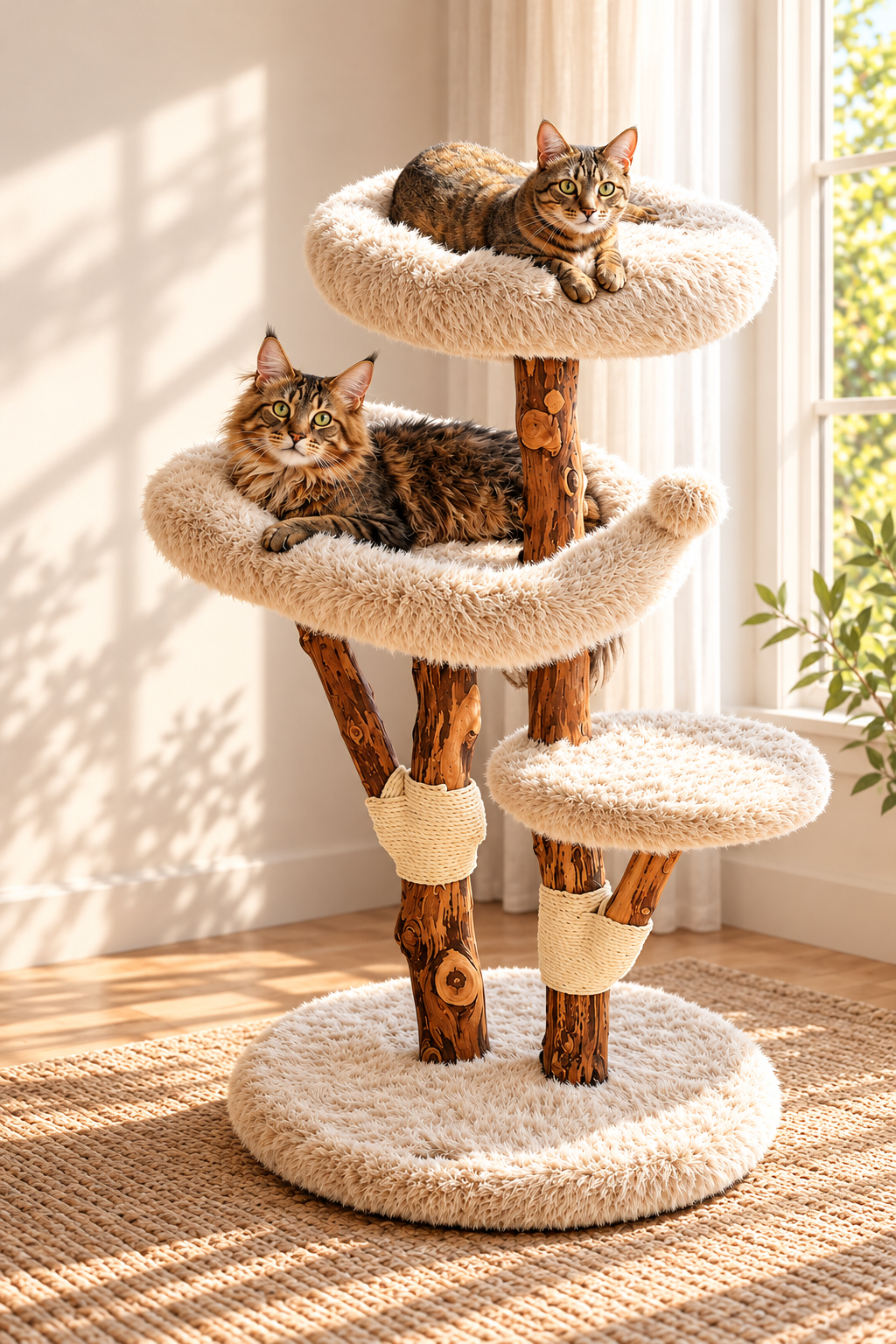
CAT TREE GUIDE
Modern Cat Trees: How to Choose One That Fits Your Home—and Your Cat

Make a Modern Cat Tree Pass Two Tests
A modern cat tree has to earn its place twice: it should give your cat useful territory, and it should fit the room well enough that you are happy to keep it there.
Use two passes before you buy:
- Cat fit: usable resting space, climbing route, scratching, footing, comfort and maintenance.
- Home fit: full furniture envelope, visual mass, wood/textile tone, cleaning burden and placement beside existing furniture.
Do not let a clean silhouette make you rationalize a poor cat fit. If you are still comparing the whole category, start with the Cat Tree Buying Guide.
Start With the Cat Jobs, Not the Finish
Before comparing wood tones, cream fabrics or Scandinavian silhouettes, identify what the furniture needs to let your cat do: climb, perch, rest, scratch, observe the room and move between levels.
Feline environmental guidance supports providing cats with appropriate safe places and environmental resources. That does not create one universal cat-tree formula, but it is a useful reminder that appearance is only one part of the decision.
A minimal-looking tree can still work very well when the useful spaces remain generous. A visually elegant tree can also fail if the cat has nowhere comfortable to settle or scratch.
Read the Silhouette and the Full Furniture Envelope Together
Visual mass and physical footprint are related, but they are not the same thing. Open frames and exposed wood can make two similarly sized trees feel very different in a room.
Measure the base, then check the widest upper perch, bowl, hammock or platform. Also check door swing, curtains, walkways and nearby furniture. A narrow base does not help if the upper structure projects into the only practical path through the room.
For small homes, the right question is not “Which tree looks the slimmest?” It is “Which complete structure fits this room without shrinking the cat’s usable space too far?”
Keep Resting and Scratching Space Useful
Look beyond the overall dimensions and inspect the top perch, main platforms, enclosed beds, bowls, hammocks and transition surfaces. Your cat should be able to use the important resting areas in a natural posture.
Scratching is also normal feline behavior. The Ohio State Indoor Pet Initiative recommends matching scratching orientation and material to the cat’s preference and making vertical posts tall enough for a useful stretch.
A modern design should therefore avoid turning scratching into a decorative strip that is too short, awkwardly placed or difficult to replace.
- Can the cat rest and turn comfortably on the main surfaces?
- Is there a practical route to and from the preferred level?
- Is the scratch surface on a route the cat is likely to use?
- Can high-wear components be cleaned, re-wrapped or replaced?
Choose Materials for How They Will Live in the Room
Modern cat furniture often exposes more of its structure than a fully carpeted tower. That makes material, edge treatment and maintenance part of the visual decision.
| Element | What to check |
|---|---|
| Wood / wood-look panels | Actual material, edge treatment, finish and realistic cleaning instructions |
| Textiles | Color, hair visibility, whether pads are removable, and the documented care method |
| Scratch surfaces | Material, usable length and whether a worn section can be serviced |
| Clear bowls / acrylic parts | Useful size, placement, cleaning access and whether the cat actually likes the format |
Do not turn aesthetic terms into material claims. “Natural,” “minimalist,” “premium” and “furniture-grade” still need component-level product information.
Placement Is Part of the Design
A tree that visually matches the sofa but sits in a location your cat rarely values is not a strong home fit. Choose the location and the product together.
Ohio State guidance includes window-adjacent perches as one way to make indoor environments more interesting. A window is not a universal requirement, but observation, social proximity and an unobstructed route are useful variables to consider.
Check that the final location does not create conflicts with doors, curtains, vents, fragile decor or awkward landing gaps.
Match the Existing Room Instead of Chasing a Trend Label
Modern, Japandi, Scandinavian, minimalist and cream are useful search terms, but they are broad visual languages rather than performance specifications.
Warm rooms may work well with natural wood tones and restrained textiles. Lighter rooms may benefit from white, cream or pale wood. A colorful accent can work when the rest of the room already uses controlled color.
The goal is not to make the cat tree invisible. The goal is to make it look intentional while keeping the cat-facing functions obvious.
Read Style and Function as Two Separate Layers
Color, exposed wood, clear acrylic, soft textiles and a restrained silhouette can help a cat tree sit more naturally in a room. None of those visual choices tells you whether the tree fits the cat.
First read the design language: color palette, visual mass, exposed materials and how the piece relates to nearby furniture. Then read the functional layer separately: usable resting dimensions, climbing route, scratching area, cleaning access and replaceable wear parts.
A modern-looking tree is a strong choice only when home fit and cat fit succeed at the same time.
Use This Two-Pass Buying Test
Pass 1: Cat fit
- Main resting surfaces fit the individual cat.
- Routes make sense for current mobility.
- Scratching surfaces are usable, not decorative.
- High-wear parts can be maintained realistically.
Pass 2: Home fit
- The full furniture envelope fits the intended location.
- Wood, textile and accent colors work with the room.
- The visual mass does not overwhelm the space.
- The cleaning routine is realistic for the household.
Common Questions About Modern Cat Trees
Are modern cat trees better than traditional cat trees?
Not automatically. “Modern” mainly describes appearance. Compare usable resting space, routes, scratching, materials, maintenance and fit for the individual cat.
Are wooden cat trees easier to match with furniture?
They often can be, especially when exposed wood and restrained geometry already appear in the room. The visual fit still does not replace checking the full product construction and cat-facing functions.
Where should a modern cat tree go?
Choose a location that works for both the room and the cat: practical observation, clear access, enough climbing clearance and minimal conflict with doors, walkways or curtains.
Is an aesthetic cat tree worth paying more for?
It can be when the extra cost buys a combination you value—room fit, useful dimensions, materials, maintenance, replaceable wear parts or a design you are happy to keep. Appearance alone does not prove better cat use or durability.
Sources and Evidence
Keep feline-environment guidance, design judgment and product specifications as separate inputs. An interior-design style is not proof of stability, safety or durability.
- AAFP/ISFM Environmental Needs Guidelines for appropriate environmental resources and safe places;
- Ohio State Indoor Pet Initiative — Scratching for scratching preferences and usable stretch;
- Ohio State — Bringing Cats Indoors for window/perch enrichment context.