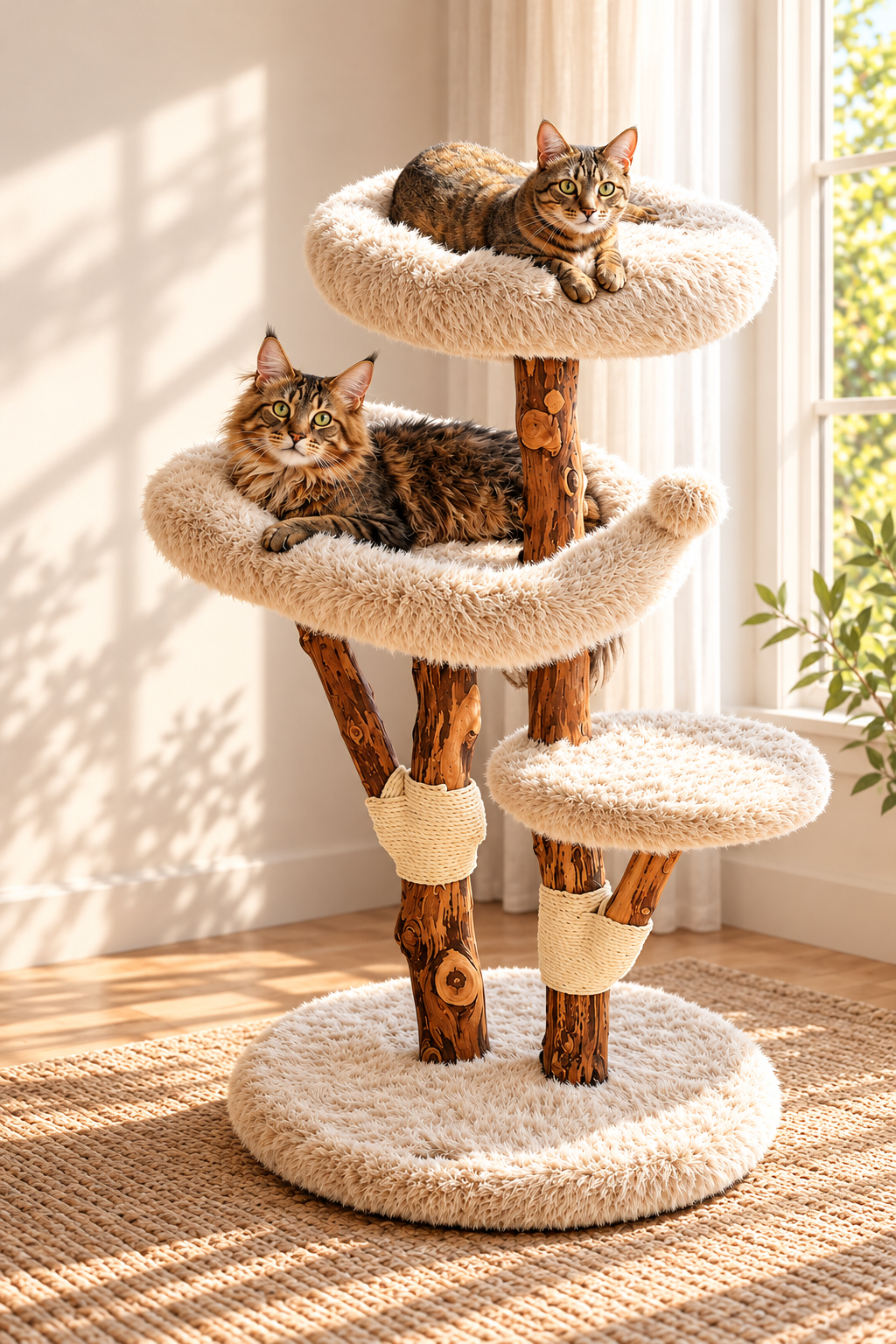
CAT TREE GUIDE
Cat Tree Buying Guide: What to Check Before You Buy

The 30-Second Pre-Purchase Checklist
A good cat tree buying decision starts with six checks, in this order:
- Measure the room footprint. Compare the listed width and depth with the actual floor area and walking clearance in your home.
- Check the spaces your cat will actually use. Read the exact perch, bed, condo, and platform dimensions instead of judging scale from photos alone.
- Read materials by component. The post material, base material, platform material, rope, and fabric can all be different.
- Keep weight fields separate. A marketplace “weight capacity” field is not automatically the same thing as a recommended cat-weight field or cat-count field.
- Check maintenance and replacement details. Look for documented removable parts, care instructions, and replacement-part availability.
- Read assembly and anti-tip instructions. Follow the instructions for the specific product rather than relying on a universal height or weight rule.
If a product page makes those six questions easy to answer, you are already working with better information than a hero photo or a broad phrase such as “natural wood.”
Start With the Space, Not the Product Photo
Cat-tree photos are useful for style, but they are a weak way to judge scale. Camera angle, room staging, wide lenses, and the size of the cat in the image can all change how large a product feels on screen.
Start with the listed footprint. Mark the width and depth on the floor with painter’s tape if the tree is large or adjustable. Then check whether doors, drawers, walking paths, vents, and nearby furniture still have enough clearance.
This matters even more for multi-level models whose upper platforms extend beyond the base. A product can occupy more usable room than the smallest contact area shown at floor level.
For adjustable or modular trees, write down both the minimum and maximum footprint. The largest configuration—not the smallest base measurement—is the number that matters when planning clearance around furniture and walking paths.
If space is your main constraint, read Cat Trees for Small Spaces.
A simple room-fit check
Before checkout, write down:
- available floor width;
- available floor depth;
- ceiling height where relevant;
- clearance around drawers, doors, desks, and sofas;
- whether the cat’s preferred approach route remains open.
The goal is not to find the smallest possible footprint. It is to understand the real space the structure will use.
Check the Spaces Your Cat Actually Uses
“Large cat tree” is not a useful sizing statement by itself. What matters is whether the specific resting and movement areas fit your cat.
Look for the dimensions of the top perch, basket, condo opening, hammock, and intermediate platforms. If those numbers are missing, that is an information gap worth noticing.
Then compare them with your own cat. Observe the space your cat uses when sleeping curled up, stretching out, turning around, or sharing a surface with another cat. You do not need a universal perch-width rule to make this comparison; you need your cat’s real resting size and the product’s real usable dimensions.
If a listing publishes only one perch dimension, treat it as incomplete fit information. Compare width and depth when available, then consider rims, nearby posts and the way your cat actually rests.
Real-world owner feedback reinforces why usable dimensions matter: a perch can look generous in photos and still feel cramped once a cat curls, stretches or turns. Use owner experience as context, then make the decision from measured dimensions and your own cat’s resting size.
For deeper sizing questions, see the Cat Tree Size Guide.
Decode the Material List by Component
A cat tree can combine several different materials, so broad product titles can be misleading if you treat them as a complete bill of materials.
| Component | What to look for |
|---|---|
| Base | Board type, thickness, footprint and attachment points |
| Platforms | Board type, thickness and usable dimensions |
| Posts | Wood, reinforced tube or another stated material; diameter where available |
| Scratch surface | Sisal, jute, carpet or another documented material |
| Fabric | Plush, upholstery fabric, removable cushion or another stated textile |
| Hardware | Assembly method and replacement information when provided |
A title such as “natural wood” can describe only part of a mixed-material structure. Identify which component each material label describes.
For a deeper material comparison, see the Solid Wood vs. Particleboard Cat Trees guide.
Read Weight Numbers Carefully
Cat-tree product pages can show several weight-related numbers, and they do not necessarily answer the same question.
- a recommended cat-weight field;
- a recommended cat-count field;
- the assembled product weight;
- a marketplace or manufacturer capacity field.
Keep those fields separate unless the manufacturer explicitly defines how they relate. A total capacity field should not be silently rewritten as a single-cat recommendation, and assembled furniture weight is not a stability score.
Why a sitting load is not the whole story
A cat does not only sit on a tree. Cats climb, jump, land, turn and launch from elevated surfaces. In a controlled domestic-cat study, peak vertical landing force increased as landing height increased. You can read the peer-reviewed PeerJ study on feline landing kinetics.
That research helps explain why movement is dynamic, but it does not create a universal cat-tree load multiplier. Do not turn a landing study into a fixed shopping formula.
For a deeper look at construction and placement, use the Cat Tree Stability Guide.
Ask Maintenance and Replacement Questions Before Checkout
Maintenance is easier to evaluate before you buy than after the first spill, worn scratch surface, or damaged part.
Look for exact answers to these questions:
- Which cushions or pads are removable?
- What cleaning method is actually specified?
- Are scratching components replaceable?
- Can individual hardware or posts be ordered?
- Does “removable” mean removable only, or is a wash method also documented?
- Are care instructions available before purchase?
Do not automatically turn “removable cushion” into “machine washable.” Those are different claims. Use the documented care method for the exact textile.
This distinction is useful across the category. Product copy often compresses maintenance into phrases such as “easy to clean.” A better product page tells you what can be removed and how it should be cared for.
For cleaning-specific guidance, see How to Clean a Cat Tree.
Placement, Assembly, and Anti-Tip Instructions Matter
A cat tree can be assembled correctly and still be placed badly for the room.
Start by following the assembly and wall-attachment instructions provided for the specific model. Do not replace the manufacturer’s instructions with a universal height rule from another furniture category.
Then look around the final placement area. Elevated sleeping surfaces should not open directly into hard furniture corners, narrow gaps, or other awkward landing zones.
Room placement matters even when the tree itself is assembled correctly. Check the area around elevated sleeping and landing zones for hard furniture corners, narrow gaps or awkward transitions, and keep likely approach and descent routes clear.
Classic feline sleep research also describes pronounced skeletal-muscle atonia during REM sleep. This is background physiology, not proof that a specific rim height prevents falls. The practical takeaway is simpler: follow the product’s assembly instructions and avoid creating obvious hard-edge or narrow-gap hazards around elevated resting areas.
Read Any Product Page as a Specification Sheet
Ignore the marketing title for a moment and extract the fields that answer real buying questions.
| Decision | Specification to find |
|---|---|
| Will it fit the room? | Minimum and maximum footprint, overall width/depth/height, upper overhang |
| Will the cat fit? | Perch, basket, hammock and condo usable dimensions |
| What is it made from? | Base, platform, post, scratch-surface and textile materials separately |
| What do the weight fields mean? | Cat weight, cat count, assembled furniture weight and capacity as separate labels |
| Can it be maintained? | Care instructions, removable parts, replaceable scratch surfaces and spare parts |
| How is it secured? | Assembly instructions and any model-specific anti-tip or wall-attachment method |
If a listing cannot answer an important question, treat that as missing information instead of filling the gap with a guess.
Save This Pre-Purchase Audit
Before buying a cat tree, confirm that you can answer each item below from the product page, manual, or seller documentation.
| Check | Question to answer before checkout |
|---|---|
| Room fit | What are the real width, depth, height, and usable clearance requirements? |
| Cat fit | What are the exact resting, perch, condo, and platform dimensions? |
| Materials | What are the base, platform, post, scratch-surface, and fabric materials separately? |
| Weight fields | Which number is cat weight, cat count, assembled product weight, or marketplace capacity? |
| Maintenance | What is removable, what is replaceable, and what care method is actually documented? |
| Setup | What do the assembly and anti-tip instructions for this exact model require? |
If a listing cannot answer an important question, treat that as missing information instead of filling the gap with a guess.
Frequently Asked Questions
How tall should a cat tree be?
There is no single universal minimum height that fits every cat and home. Choose a height and layout that fit the room and provide useful elevated options for your cat, then follow the exact assembly and attachment instructions for that model. The AAFP and ISFM Feline Environmental Needs Guidelines support providing cats with safe places and appropriate environmental resources, but they do not provide a universal cat-tree height threshold.
How can I tell whether my cat will fit the top perch?
Use the actual perch dimensions and compare them with your own cat’s resting and stretching size. Do not rely on listing photography alone. If a product does not publish usable resting dimensions, note that as an information gap.
Is “natural wood” the same as an all-solid-wood cat tree?
No. Read the component materials. A product can use real wood for posts while using manufactured board for the base or platforms. Treat the material list as a component map, not a single all-or-nothing label.
What does a cat-tree weight number mean?
First identify the field. Recommended cat weight, cat count, assembled product weight, and marketplace weight capacity are different data points. Do not convert one into another unless the manufacturer defines that relationship.
Do I need to use a wall anchor?
Follow the assembly and anti-tip or wall-attachment instructions supplied for the exact product. Do not substitute a universal height threshold for the instructions of the specific model.
What should I check for easier maintenance?
Look for exact care instructions, documented removable components, and replacement-part availability. Do not assume that a removable textile is machine washable unless the product instructions actually say so.
Sources and Evidence
Use product specifications, research context and owner experience as separate inputs. Each answers a different part of the buying decision.
The main non-commercial sources used for general context are:
- the AAFP and ISFM Feline Environmental Needs Guidelines;
- the PeerJ domestic-cat landing kinetics study;
- supporting feline landing biomechanics research in the Journal of Bionic Engineering;
- mammalian sleep context from Siegel’s review in Nature.
Ready to compare current models? Explore all cat trees, or browse cat trees for large cats if that is your main fit constraint.