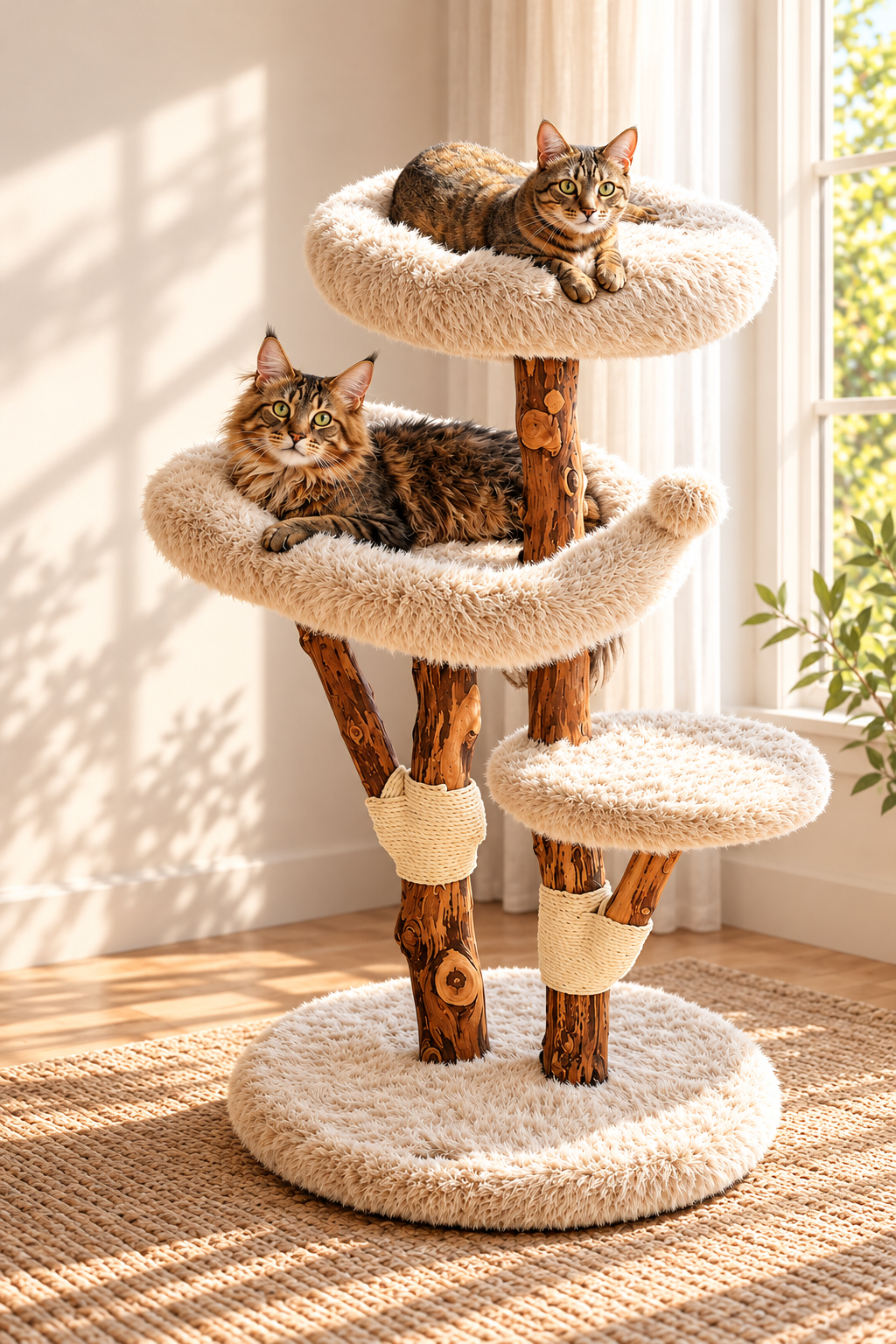
CAT TREE GUIDE
How to Clean a Cat Tree: Fur, Vomit, Urine & Everyday Grime

Match the Cleaner to the Mess and the Surface
A cat tree is not one material. It may combine removable cushions, fixed upholstery, sisal rope, coated wood, engineered board, foam, adhesives, hardware and exposed joints.
That is why the safest cleaning question is not simply “What cleaner should I use?” It is:
What happened, and what surface did it happen on?
| Mess | First move | What comes next |
|---|---|---|
| Loose fur, dust or litter | Vacuum or brush while dry | Work top to bottom; use a crevice tool around joints and beds |
| Fresh vomit / hairball | Lift solids, then blot | Spot-clean only with a product compatible with that surface |
| Urine | Blot as much liquid as possible | Use a surface-compatible urine odor/stain product; an enzymatic cleaner may help with residual odor |
| Everyday grime | Dry-clean first | Use minimal compatible moisture only where needed |
Three rules apply to almost every cat tree: start dry before you start wet; follow the care instructions for the specific material or removable part; and keep your cat off cleaned areas until everything is fully dry.
If your tree is also becoming loose, tilted or wobbly, cleaning is no longer the only maintenance issue. Continue with our Cat Tree Stability Guide to diagnose sliding, rocking, loose joints and sway before choosing a fix.
Before You Add Water, Find Out What the Tree Is Made Of
Look at the cat tree as a group of separate surfaces.
Removable cushions and pads
These are usually the easiest parts to maintain because you can remove them from the structural frame. But removable does not automatically mean machine washable.
Check the sewn-in care label, the manufacturer’s instructions, whether the pad contains foam or another insert, and whether hook-and-loop fasteners, zippers or trim have separate care requirements.
Fixed plush, carpet or upholstery
This material cannot be separated from the board or padding beneath it, so moisture control matters more. Start with vacuuming, a crevice attachment, and a lint tool or fabric brush. For a stain, spot-clean the smallest necessary area instead of soaking the whole platform.
Sisal or rope
Sisal-wrapped posts collect fur, dust, litter particles and debris between rope turns. Start dry: vacuum in the direction of the wrap and use a soft brush where debris is trapped.
Do not assume a wrapped post can be sprayed, soaked or steam-cleaned simply because the outer fiber looks durable. The post underneath, adhesive and attachment method may have different care limits.
Sealed hard surfaces
A coated hard surface may tolerate wiping better than fixed plush, but the finish still matters. Use a soft cloth and a compatible cleaner. Avoid letting liquid pool around seams, fasteners, screw holes or exposed board edges.
Exposed board edges, joints or unknown construction
If you do not know what is under the fabric—or you can see an engineered-wood edge—do not treat the tree like outdoor furniture that can be hosed down. Use the least moisture necessary and dry the area thoroughly.
For a deeper next step, see our Solid Wood vs Particleboard Cat Trees.
Fur, Dust and Litter: Start Dry
For most homes, loose fur is the most common cat-tree mess—and the easiest to manage.
- Remove loose accessories. Take off cushions, blankets and toys that are designed to come off.
- Vacuum the highest resting areas first. Work downward so loosened fur falls onto surfaces you have not cleaned yet.
- Use the right attachment. An upholstery tool handles broad fabric areas; a crevice tool reaches platform edges, condo corners and the base of posts.
- Brush stubborn fur before vacuuming again. A fabric brush or lint-removal tool can loosen hair embedded in plush fibers.
- Vacuum rope gently. Follow the direction of the rope wrap instead of dragging aggressively across loose fibers.
Cleaning time is inspection time
While you work, look for loose hardware, moving platforms, torn fabric, rope pulling away from the post, exposed fasteners or soft/swollen board edges.
A clean cat tree is not automatically a safe cat tree. If the structure has changed, fix the structural issue before your cat uses it again.
Fresh Vomit or a Hairball: Lift, Blot, Then Spot Clean
The goal is to remove the mess without pushing it farther into fabric, foam or board.
- Lift solids first. Use paper towel or another disposable tool to pick up the bulk of the material.
- Blot. Press with an absorbent cloth or paper towel. Work from the outside of the spot toward the center.
- Identify the surface underneath. Is the cover removable? Is this fixed plush? Is there foam beneath it? Is the board edge exposed?
- Spot-clean according to the care instructions. Use a cleaner intended for that surface and only enough to treat the affected area.
- Dry completely. Do not put a damp removable cushion back onto the tree.
When the vomit is not just a cleaning problem
Cats can vomit occasionally, but frequent vomiting deserves attention. Cornell’s Feline Health Center advises veterinary evaluation when vomiting occurs more than once a week or appears with signs such as lethargy, weakness, reduced appetite, blood, changes in thirst or urination, or diarrhea.
Clean the tree, but do not let a cleaner hide a recurring health signal.
Treat the Odor Without Flooding the Structure
Urine is the mess that most often tempts owners to use more product, more water and more fragrance. That can make a mixed-material cat tree harder—not easier—to recover.
- Blot immediately. Absorb as much liquid as possible before adding anything else.
- Determine how deep the liquid may have traveled. A removable pad is different from fixed foam, glued carpet, an exposed board edge or the base of a wrapped post.
- Choose a surface-compatible urine odor/stain product. FelineVMA guidance recommends an appropriate product for the surface and advises testing it on an inconspicuous area first.
- Consider an enzymatic cleaner for residual odor. VCA includes enzymatic cleaners as an option for removing residual urine odor. Follow the product label and surface restrictions.
- Skip ammonia-based cleaners for urine spots. FelineVMA advises avoiding them because the odor can resemble urine to cats.
- Let the area dry fully. Keep your cat away until the cleaned surface is dry and aired out.
If your cat urinates on the tree again, do not keep escalating the cleaner indefinitely. Repeated urination outside the litter box can have medical, litter-box, environmental or behavioral causes. Contact your veterinarian if it continues.
How to Clean Each Cat-Tree Surface
Removable cushions and pads
Remove the pad, vacuum loose fur, check the care instructions, wash or spot-clean only as directed, dry completely, then reattach.
Avoid assuming that “washable” means hot water, machine wash, tumble dry, bleach or fabric softener. Those details need to come from the actual care instructions.
Fixed fabric or plush
Vacuum thoroughly, brush embedded hair, blot fresh liquid, spot-clean with a compatible product, remove excess moisture, and dry fully. The hidden layer may be foam, adhesive or engineered board that should not be saturated.
Sisal and rope-wrapped posts
Vacuum gently, brush between rope turns and inspect the rope attachment. Avoid unnecessary saturation. If a rope section remains badly contaminated or is physically worn out, replacing the rope or post may make more sense than repeatedly wetting the entire structure.
Sealed hard surfaces
Remove dry debris, wipe with a soft cloth and compatible cleaner, avoid pooling liquid at edges/holes/joints, and dry before reuse. “Water-resistant” does not automatically mean an assembled tree can be soaked.
Exposed engineered-wood edges or joints
If liquid reaches an exposed edge, fastener hole or joint, blot rather than flood, dry the area and inspect afterward for softening, swelling, delamination or looseness. If the material has physically changed, cleaning is not a structural repair.
Can You Steam Clean a Cat Tree?
There is no useful universal yes/no answer. Some consumer guides recommend steam in certain circumstances; other surface-specific guidance warns against applying it to common cat-tree fabric or sisal areas.
The reason is simple: “cat tree” is a product category, not a material specification.
Before using steam, confirm that the manufacturer permits it, the visible surface tolerates it, the backing/adhesive/core will not be damaged, and the part can dry completely.
If you cannot verify those points, vacuuming plus targeted spot cleaning is the safer starting position.
When Cleaning Is No Longer the Right Fix
Cleaning restores a surface. It does not repair every form of wear or contamination.
Consider repair, part replacement or retiring the tree when you find:
- a cushion or porous part that remains strongly contaminated after appropriate cleaning;
- rope that is badly detached or structurally worn;
- a platform or board edge that has swollen, softened or delaminated;
- a joint that stays loose after correct re-tightening;
- a base that no longer sits flat;
- an exposed sharp fastener;
- persistent structural wobble.
If one replaceable cushion is the problem, replacing one cushion can be more sensible than replacing an otherwise sound cat tree. If the structural frame is compromised, a clean cushion does not make the tree safe.
For structural diagnosis, use the Cat Tree Stability Guide as the next step.
Easier-Care Cat Tree Design: What to Look For Next Time
Maintenance begins before the first stain. When comparing cat trees, look for removable soft parts where specified, vacuum-accessible surfaces, clear care instructions and replaceable high-wear components.
Separate “removable” from “washable”
A removable cushion is easier to access, but that label alone does not tell you whether it can be machine washed, hand washed or only spot cleaned. Use the care instructions for the exact textile.
Check access before you buy
- Can you reach fabric seams and corners with a vacuum?
- Can cushions or covers be removed without dismantling the whole tree?
- Are scratching surfaces or other wear parts replaceable?
- Are cleaning instructions specific enough to avoid guessing?
Good care information should reduce guesswork, not replace it with another assumption.
Your 10-Step Cat-Tree Cleaning Order
- Inspect the tree for loose or damaged parts.
- Remove cushions, toys and accessories designed to come off.
- Vacuum dry from top to bottom.
- Brush stubborn fur from fabric or rope.
- Treat only the spot that needs moisture.
- Blot instead of flooding porous fixed surfaces.
- Follow the label for any cleaner or removable textile.
- Dry everything completely.
- Reassemble only according to product instructions.
- Check stability again before your cat returns.
Common Cat-Tree Cleaning Questions
Can I use an enzyme cleaner on a cat tree?
An enzymatic cleaner can be useful for residual cat-urine odor. Use a product intended for the surface, follow its label and spot-test where appropriate. Do not saturate hidden foam, board or joints just because the visible fabric tolerates the cleaner.
Can I use vinegar to clean a cat tree?
Do not assume one homemade vinegar ratio is appropriate for every cat-tree material. Upholstery, finishes, adhesives, foam and engineered board can respond differently. Follow the product’s care instructions or use a cleaner specifically compatible with the surface.
Can I machine wash a removable cat-tree cushion?
Only when the care instructions say it is machine washable. Removable and machine washable are not synonyms.
Can I use essential oils to make the tree smell better?
We do not recommend essential oils as a cat-tree deodorizing shortcut. ASPCA notes that cats are especially sensitive to essential oils. Remove the odor source and use a compatible cleaning method instead.
How often should I clean a cat tree?
There is no universal schedule that fits every home. Vacuum or remove fur when it accumulates, deal with urine or vomit promptly, and deep-clean only as the materials and care instructions allow.
What if the urine smell comes back?
Residual contamination may remain deeper in a porous part, in which case targeted re-treatment or part replacement may be necessary. If your cat continues urinating outside the litter box, contact your veterinarian and investigate the cause rather than treating it only as a cleaning issue.
A Cleaner Cat Tree Is Mostly About Better Decisions
You do not need the strongest cleaner. You need the right method for the specific mess and the specific material.
Start dry. Separate removable parts when possible. Spot-treat instead of flooding. Follow care labels. Let everything dry fully. And know when a cleaning problem has become a repair, replacement or health problem.
If you are choosing your next tree, start with our Cat Tree Buying Guide or shop all cat trees and include maintainability—not just height and style—in your comparison.