CAT TREE GUIDE
Non-Toxic Cat Tree Guide: How to Read TSCA Title VI, CARB Phase 2 & Material Claims

Read the evidence chain, not the adjective
A strong “new furniture” smell can make a cat owner uneasy. A product page that says non-toxic, P2, CARB Phase 2, TSCA Title VI, or low VOC can sound reassuring. Those phrases do not all mean the same thing.
Use this sequence: Identify the material → Check which rule applies → Verify the label or documentation → Separate marketing from compliance → Decide.
- What exact panel material is used?
- Is that panel covered by TSCA Title VI composite-wood rules?
- Can the seller identify the relevant compliance label or supplier documentation?
- Is the claim tied to this product or panel?
- Are “P2,” “non-toxic,” “low VOC,” or “FSC” being treated as if they were identical?
Start with the material
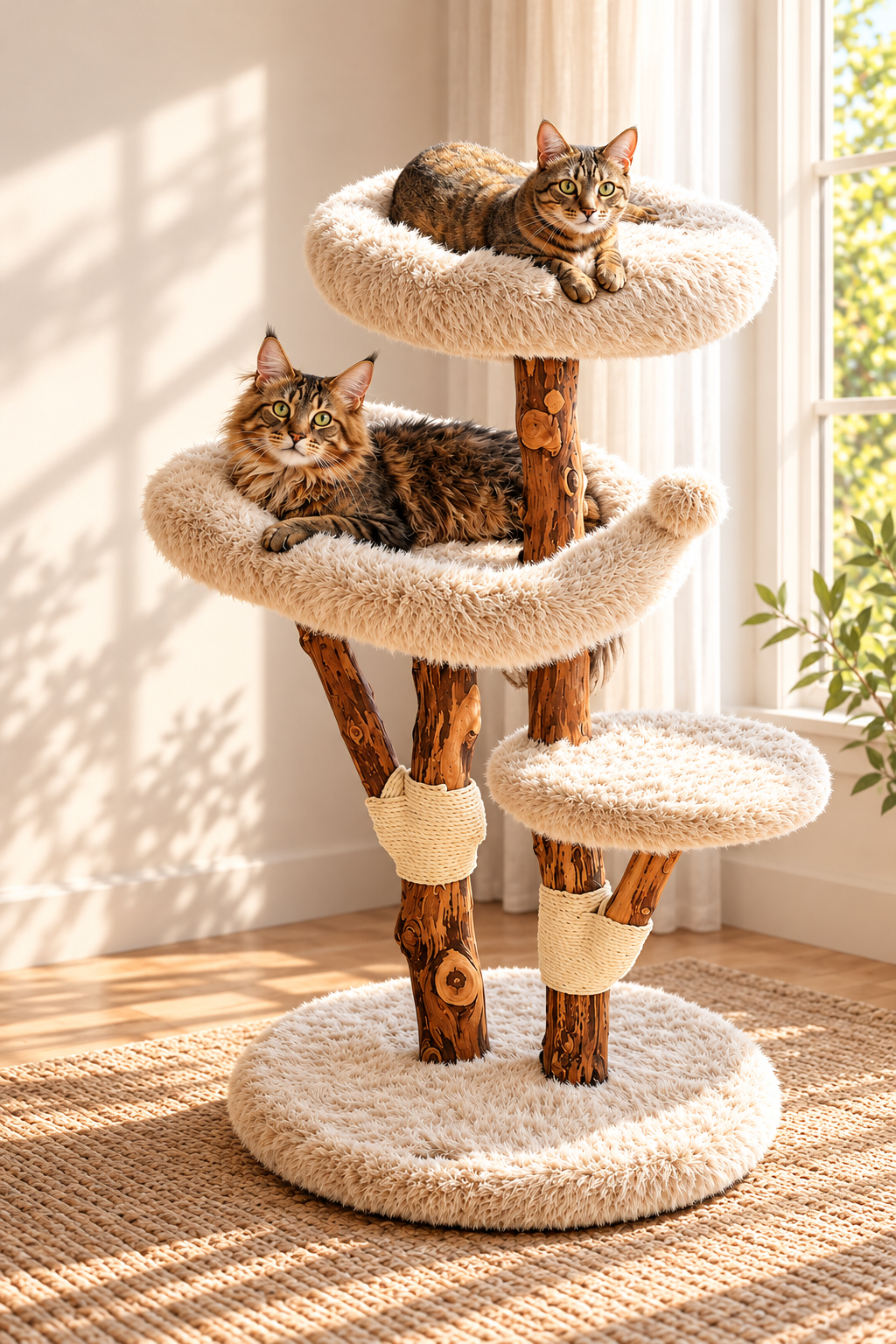
“Wooden cat tree” can describe a mixed construction: solid-wood posts, plywood or particleboard platforms, cardboard tubes, fabric, rope, adhesives, coatings and hardware.
A better question than “Is this cat tree non-toxic?” is: Which components are regulated composite wood, and what evidence supports the finished product’s claims?
EPA’s formaldehyde rule covers regulated composite-wood panels such as hardwood plywood, particleboard and MDF, including finished goods that contain them. It does not turn the whole cat tree into a universal “chemical-free” product.
What TSCA Title VI actually regulates
EPA’s TSCA Title VI formaldehyde standard applies to specified composite-wood products, including hardwood plywood, particleboard, MDF and thin MDF, plus finished goods that contain regulated panels. Being made with regulated composite wood does not by itself mean a product is unsafe; the useful question is whether the applicable material and documentation meet the relevant requirements.
The rule includes panel testing, third-party certification, labeling, recordkeeping and import requirements. For a shopper, compliance should therefore connect to a specific material and documentation trail, not only a green badge or general adjective.
The formaldehyde limits are not all 0.05 ppm
| Regulated panel | EPA emission standard |
|---|---|
| Hardwood plywood | 0.05 ppm |
| Particleboard | 0.09 ppm |
| MDF | 0.11 ppm |
| Thin MDF | 0.13 ppm |
So 0.05 ppm is not a universal formaldehyde limit. Always connect the number to the panel type: material first, number second, standard third.
CARB Phase 2 and TSCA Title VI
California’s composite-wood regulation preceded the federal EPA rule, and the covered-panel emission limits were aligned. EPA implementation guidance explains the federal TSCA Title VI compliance route for regulated composite-wood products manufactured or imported into the United States after March 22, 2019.
CARB consumer guidance also explains the California framework and acceptance of TSCA Title VI compliant labeling. For a current purchase, ask whether the finished good can be connected to compliant regulated panels and an applicable label/document trail.
What product evidence should look like
Depending on the supply-chain stage, evidence may include a finished-good or packaging compliance statement, fabricator/producer identity, production information, panel producer information, supplier records or third-party certifier information for regulated panels.
A consumer may not automatically receive every upstream record. But a seller should be able to answer a more specific question than “Don’t worry, it is non-toxic.”
What composite-wood panel is used in this model, and what TSCA Title VI compliance documentation or labeling supports it?
Keep P2, FSC, “non-toxic” and low VOC separate
P2
A standalone P2 label can be ambiguous. Ask what standard the seller means and what documentation applies to the exact panel or finished product; do not treat P2 alone as proof of TSCA Title VI compliance.
CARB Phase 2 / TSCA Title VI
These refer to formaldehyde-emission requirements for regulated composite wood and are more specific than a general environmental adjective.
FSC
FSC sourcing claims and formaldehyde-emission compliance answer different questions. Do not use one as proof of the other.
“Non-toxic” / “Low VOC”
Ask what test, standard, material scope or document supports the claim. The phrase itself is not a substitute for a product-specific regulatory label.
What a strong smell can—and cannot—tell you
Owner communities repeatedly describe the same problem: a new cat tree smells strongly of glue or “chemicals,” and the buyer does not know whether to keep it. Some owners report returning products or seeking other sources when the odor persists and documentation is unclear.
That is real consumer experience, but smell is not a laboratory test.
A smell can tell you
- you notice an odor;
- you may want more ventilation;
- you may want to contact the seller;
- you may decide the product is unacceptable for your household.
A smell cannot tell you by itself
- which chemical is present;
- the formaldehyde concentration;
- whether a panel passes or fails TSCA Title VI;
- whether the whole product is “toxic” or “safe.”
Likewise, no smell does not prove compliance. Check the material and evidence chain instead of guessing a ppm value with your nose.
Solid wood changes the question, not the need for evidence
Solid wood is not the same regulated composite-wood panel category as particleboard, MDF or hardwood plywood. But a finished cat tree can still contain adhesives, finishes, textiles, rope treatments, plastic parts or composite components.
“Solid wood” is a useful construction fact. It is not a universal safety certificate. Evaluate a mixed-material cat tree component by component.
Five questions to ask a seller
- What exact board material is used? Particleboard, MDF, hardwood plywood, another plywood, solid wood or a combination?
- Is the compliance claim specific to this product?
- What label or documentation supports the claim?
- What does “P2” or “non-toxic” mean in this listing?
- Does the seller disclose the whole material system? Posts, scratching material, fabrics, pads, finishes and replaceable parts matter too.
Where to Draw the Evidence Boundary
If a listing uses only P2, do not automatically expand that label into CARB Phase 2 certification, EPA TSCA Title VI certification or a specific ppm value without supporting documentation.
Before treating a certification claim as established, verify that the supporting document applies to the exact material or finished product being sold.
Do not judge a cat tree as “non-toxic” from a marketing label alone. Compare the documented construction and materials first, then request the specific compliance document when that evidence matters to your purchase.
A 30-second evidence check
- Material identified?
- Regulated composite wood or not?
- Correct standard tied to the correct panel type?
- TSCA Title VI label/document trail available when applicable?
- No blanket 0.05 ppm claim applied to every panel?
- P2, FSC and “non-toxic” kept separate?
- Claim specific to this product, not just the factory?
- Whole finished good considered—not only the visible wood?
- Odor treated as a reason to investigate, not a ppm measurement?
Common questions
Is particleboard automatically unsafe for a cat tree?
No. Particleboard is one of the regulated composite-wood panel types under TSCA Title VI. The useful question is whether the relevant panel and finished-good supply chain meet applicable requirements and whether the claim is traceable.
Is CARB Phase 2 the same as TSCA Title VI?
They are closely related formaldehyde-emission frameworks, and the covered-panel emission limits were aligned. For regulated products manufactured/imported into the U.S. after March 22, 2019, TSCA Title VI is the current federal compliance route.
Does P2 mean a cat tree is TSCA Title VI compliant?
Not by itself. P2 needs context and product-specific evidence. Ask which standard the label refers to and verify the supporting document before treating it as proof of CARB Phase 2, TSCA Title VI or a specific ppm value.
Does a chemical smell mean the cat tree has too much formaldehyde?
Smell alone cannot identify a chemical, concentration or compliance status. If an odor is strong or unacceptable, ventilate the area, contact the seller and ask for product-specific material/compliance information.
Is solid wood always the safest option?
Solid wood changes the composite-wood question, but a finished cat tree can still contain finishes, adhesives, textiles, rope, hardware, plastics or composite components. Evaluate the whole material system.
What proof should I ask the seller for?
Start with the exact panel/material used, then ask for the applicable finished-good label or supplier/compliance documentation that ties the claim to that product or material chain.