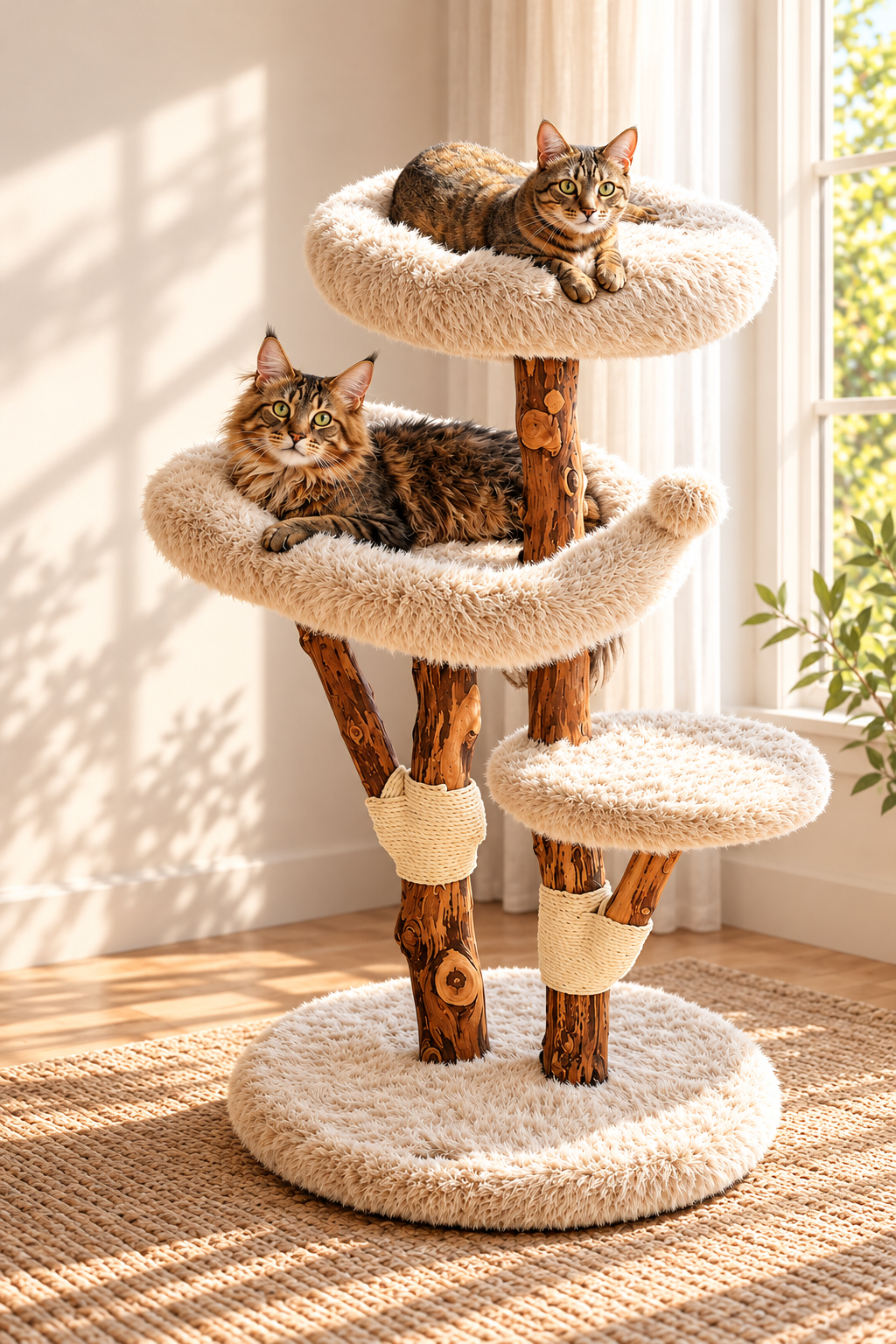
CAT TREE GUIDE
Solid Wood vs Particleboard Cat Trees: Read the Materials by Component

Don’t Buy a Material Label — Buy a Construction System
If you are comparing a “solid wood cat tree” with a cheaper particleboard model, the most useful question is not simply Which material is better?
Ask instead:
- What is the base made from?
- What are the platforms made from?
- What is inside the posts?
- What are the relevant thicknesses or diameters?
- How are those parts joined?
- Which surfaces can be cleaned, removed, re-wrapped, tightened or replaced?
- What compliance or material claims are actually documented?
A cat tree is not one block of material. It is a small furniture system made from panels, posts, scratch surfaces, textiles and hardware. A well-designed tree can combine different materials for different jobs.
That is why a listing that says “natural wood,” “wooden,” or even “engineered wood” is only the beginning of the material conversation—not the answer.
If you are still comparing the whole product rather than materials specifically, start with the Cat Tree Buying Guide.
Four Materials You’ll Commonly See
Solid wood
“Solid wood” generally means a part is made from milled lumber rather than a panel made from particles, fibers or veneer layers.
On a cat tree, solid wood may appear in posts, frames, rails, braces or decorative structural pieces. That does not necessarily mean every platform and base is also solid wood.
Solid wood can be attractive, repairable and visually furniture-like. It can also add weight, price and variation from piece to piece. Species, section size, grain direction, joinery and finishing still matter.
Plywood or multilayer board
Plywood is an engineered wood panel made from layers of veneer. APA describes plywood as thin layers of cross-laminated wood veneer bonded under heat and pressure.
That layered construction is why plywood should not be treated as “fake wood” or automatically placed below solid lumber. It is a legitimate panel material used in furniture and construction.
On a cat tree, plywood or multilayer board is often well suited to platforms, bases, shelves, and curved or shaped panels. The important follow-up questions are the panel grade, actual thickness, span, edge treatment and connection method.
Particleboard
The U.S. EPA defines particleboard as a panel made from discrete cellulosic particles pressed together with resin.
Particleboard is common in furniture because it can provide a flat, consistent panel at a lower material cost than many solid-wood options.
That does not make every particleboard cat tree “bad.” A short, compact tree with adequately sized panels can have very different demands from a tall multi-level structure. Thickness, unsupported span, fastener design and exposure to moisture all matter.
What you should avoid is using the single word “particleboard” as a substitute for the rest of the specification.
Reinforced paper or cardboard-tube posts
Many cat trees use a tube core under sisal, jute or fabric. That core can reduce weight and provide a round surface for scratching material.
Again, the material name alone does not tell you whether the whole structure is appropriate. Ask what diameter the post is, how it is attached at each end, whether it is carrying a major platform or mainly supporting a scratching surface, and whether it can be tightened, replaced or re-wrapped.
Owner discussions often focus on post replacement because a scratching surface may wear before the rest of the tree. That makes maintainability a useful buying criterion alongside material.
Material Role Matters More Than a Single “Wood” Badge
A product page should let you read the cat tree component by component.
| Component | Useful questions |
|---|---|
| Base | Material? Thickness? Footprint? How are posts attached? |
| Platforms | Material? Thickness? Unsupported span? Edge finish? |
| Posts | Solid wood, tube or another core? Diameter? Connection at both ends? |
| Scratch surface | Sisal, jute, carpet or another material? Replaceable or re-wrappable? |
| Textile | Fixed carpet/plush or removable pad? Exact care instruction? |
| Hardware | Bolts, inserts, screws or another system? Can joints be re-tightened? |
This is a more useful framework than asking whether the product is simply “wood.”
A tree with solid-wood posts and particleboard platforms is a mixed-material product. So is a tree with multilayer platforms and tube posts. Neither description is automatically a verdict.
The buyer’s job is to understand what each component is doing.
What to Check Beyond the Material Name
Thickness
Two panels made from the same material can behave very differently if one is substantially thicker or spans a shorter distance between supports.
When a listing provides board thickness, keep it attached to the exact component. Do not turn one base thickness into a claim about every platform.
Geometry and support
A platform supported near several points is a different structural problem from a long platform extending far beyond one post. Material is only one input. Layout matters too.
For stability-specific questions, continue with the Cat Tree Stability Guide.
Joinery and hardware
Buyers often focus on the visible wood while ignoring the connection system.
Ask whether the joints can be re-tightened after moving or repeated use. Read the assembly instructions. Check whether replacement hardware or posts are available.
A premium material connected poorly is still a poor construction system.
Edge and surface treatment
Panel edges tell you a lot about how the product is intended to live in a home. Check whether edges are exposed, sealed, banded, laminated or fully covered by fabric.
This matters for cleaning and everyday wear, but do not assume a specific moisture-resistance rating unless the manufacturer gives one.
Replaceability
Owner discussions around long-lived cat furniture repeatedly return to a practical point: owners do not necessarily want an indestructible object; they want the worn part to be serviceable.
That may mean replacing a post, re-wrapping a scratch surface, washing a removable pad, re-tightening hardware, or replacing one textile instead of the entire tree.
That is a different kind of value from simply paying for more wood.
Moisture, Cleaning and Daily Ownership
Material comparisons often become too abstract. In a real home, cleaning can matter just as much as panel construction.
A heavily upholstered tree may hide the underlying panel completely. A cleaner-looking wood or laminate surface may be easier to wipe, while removable pads may be easier to wash separately.
But be precise with the claim.
- “Removable” does not automatically mean “machine washable.”
- “Wood-look” does not tell you the core material.
- “Easy to clean” does not tell you which cleaning products or moisture levels are safe.
Before buying, look for exact removable components, exact care instructions, replaceable scratch surfaces, exposed versus permanently upholstered areas, spill guidance and replacement-part availability.
For surface-specific care methods, see How to Clean a Cat Tree rather than assuming one cleaning method works for every material.
“Non-Toxic,” P2, CARB and TSCA: Read the Evidence
This is one area where material marketing can become misleading quickly.
The EPA’s TSCA Title VI rules cover specific composite-wood categories, including certain hardwood plywood, MDF and particleboard products. The rules define the regulated materials and their formaldehyde-emission requirements.
The practical consumer lesson is not that composite wood is automatically unsafe.
The useful questions are:
- What exact panel category is being used?
- What certification, test report or supplier documentation is provided?
- Does the claim apply to the panel itself, the finished good, or only a marketing field?
- Can the seller show evidence for the specific product or material batch?
A standalone P2 field should not be rewritten as “EPA TSCA Title VI certified,” “CARB certified,” or a specific ppm result without supporting documentation for the relevant panel or finished product.
For the EPA’s definitions and regulatory scope, see the Formaldehyde Standards for Composite Wood Products FAQ.
Read the Material System, Not the Headline
A cat tree can mix real wood, engineered board, paper-tube or wood posts, textiles, rope and metal hardware. A broad title such as “wood cat tree” does not tell you which material is used in each structural part.
| Component | What to verify |
|---|---|
| Base and platforms | Solid wood, plywood, particleboard or another stated panel; thickness when available |
| Posts | Solid wood, laminated wood, reinforced tube or another stated structure |
| Scratching surface | Sisal, jute, carpet or another documented material; attachment and replaceability |
| Textiles | Fabric type, removable parts and documented care method |
| Connections | Hardware, re-tightening access and replacement-part availability |
The useful question is not “Is this a wood tree?” It is “What is each load-bearing, resting and wear component actually made from?”
Which Construction Strategy Fits You?
There is no universal material winner. Start with your own constraint.
If you move frequently
Prioritize manageable assembled/package weight, modular parts, joints that can be re-tightened and clear disassembly instructions. A very heavy all-wood tree may be excellent once placed but inconvenient for a renter who moves often.
If cleaning is your biggest concern
Prioritize removable pads, accessible hard surfaces, clear textile-care instructions and replaceable scratch components. The easiest tree to maintain may not be the one with the most expensive core material.
If you have large or multiple active cats
Prioritize usable platform dimensions, footprint and support layout, post and panel specifications, connection design and the manufacturer’s assembly/anti-tip instructions. Do not use “solid wood” as a substitute for those checks.
If aesthetics matter
Solid wood, visible multilayer edges and furniture-style finishes can be attractive, but a surface finish does not tell you the entire structure. Choose the look you want, then verify the hidden components.
If budget is the deciding factor
A lower-cost material strategy is not automatically a mistake. A better question is whether the product is transparent enough for you to judge the parts you will use, the parts most likely to wear, what can be maintained and what must be replaced if damaged.
Price is not a material specification.
Save This Material Audit
Before paying extra for a “wood” cat tree, make sure you can answer these seven questions:
- What is the base material and thickness?
- What are the platform materials and thicknesses?
- What is the post core?
- What is the scratch material?
- How are the main parts joined and re-tightened?
- Which surfaces are removable, washable, re-wrappable or replaceable?
- What documentation supports environmental/compliance claims?
If a listing cannot answer most of these, the problem is not necessarily the material. The problem is that you are being asked to buy without enough information.
Common Questions About Cat Tree Materials
Is plywood the same as particleboard?
No. Plywood is made from veneer layers, while particleboard is made from discrete wood/cellulosic particles pressed with resin. They are different engineered wood products.
Is engineered wood automatically low quality?
No. “Engineered wood” is a broad category. The exact panel type, grade, thickness, span and connection system matter.
Does “natural wood” mean a cat tree is fully solid wood?
Not necessarily. Check which components are actually wood. A product may combine wood posts with manufactured board platforms or bases.
Is particleboard automatically unsafe?
No. Material identity by itself does not establish whether a finished cat tree is safe or unsafe. Evaluate the full construction and follow the product’s assembly and placement instructions.
Are cardboard-tube posts automatically bad?
No. Ask what role the post serves, its dimensions, how it is connected and whether it can be maintained or replaced. A material label alone is not enough to judge the whole tree.
What should I check before paying more for a wood cat tree?
Check the component-level material list, thicknesses, post cores, connection system, replaceable/cleanable parts and actual documentation behind environmental claims.
Sources & Editorial Standards
Keep general material definitions separate from product-specific claims: the name of a material does not prove how an entire cat tree is constructed.
Owner feedback can help surface practical concerns around maintainability, cleaning and value, but they should not be treated as engineering tests.
Continue with the Cat Tree Buying Guide, Cat Tree Size Guide, the Cat Tree Stability Guide, or Browse All Cat Trees.