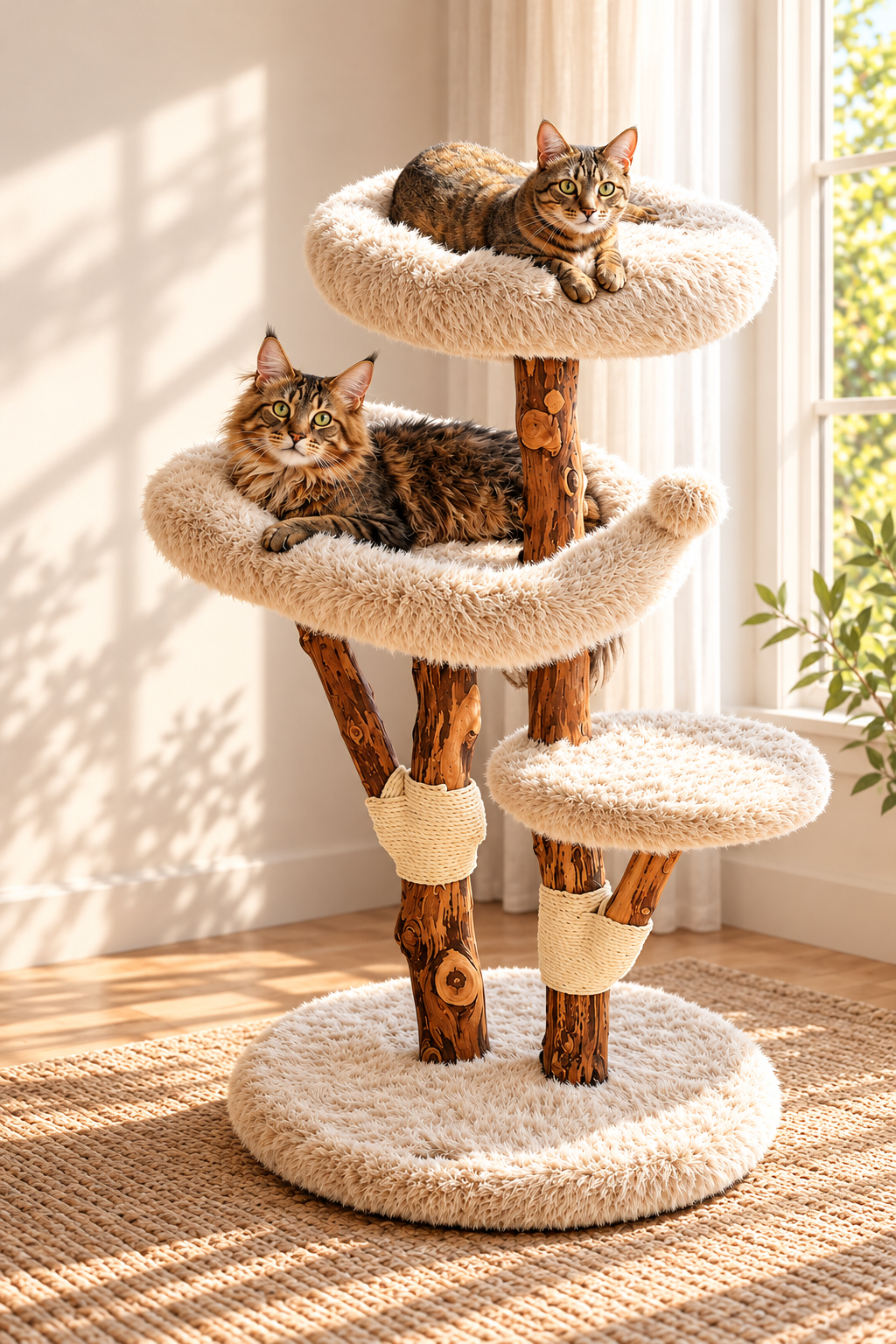
CAT TREE GUIDE
Multi-Cat Tree Guide: How to Choose More Space, Better Routes & Real Fit

Use the Six-Point Multi-Cat Check
If you live with two or more cats, the most useful question is not “How many levels should a multi-cat tree have?”
Does this setup give each cat enough choice to climb, rest, scratch, watch the room and get away without depending on one contested spot?
A large tower can be part of that answer. Sometimes a second perch, window seat or cat tree in another room is more useful than adding another level to the same structure.
- Usable resting zones — count full-size places a cat can actually settle, not decorative steps.
- Choice — is there more than one desirable place to rest, watch or hide?
- Routes — can you see reasonable ways up and down without one obvious chokepoint?
- Fit — does the largest cat physically fit on the preferred beds and platforms?
- Stability — does the structure look built for repeated climbing, landing and movement?
- Placement — will it sit where your cats already want to spend time, with other vertical options elsewhere?
If one cat repeatedly occupies the only desirable top perch while another avoids the structure, the answer may be more distributed choice, not simply a taller tower.
Can Multiple Cats Share One Cat Tree?
Yes, multiple cats can use the same cat tree—but “share” does not always mean they will all want to use it at the same time.
Cats living in the same home may be socially bonded, may tolerate one another, or may belong to different social groups. Feline environmental guidance also notes that cats may time-share common resting and perching locations.
A useful multi-cat setup therefore does not have to look like a marketing photo with three cats piled onto one tower. A better goal is enough attractive places to choose from, elevated options at different heights, more than one type of resting space, and alternatives elsewhere in the home.
If your cats already sleep together, groom one another and voluntarily share space, they may happily use the same structure. If they prefer distance, the environment should not force them to negotiate one “premium seat.”
Count Usable Zones, Not Marketing Levels
“Eight levels” sounds impressive until you look closely. A base, three transition steps, a scratching platform, a condo roof and a top bed do not provide eight equal resting choices.
| Zone type | Ask this question |
|---|---|
| Resting perch | Can an adult cat actually lie down here? |
| Hide / condo | Is the opening and interior usable for my cat? |
| Transit step | Is this mainly a way to move between levels? |
| Scratch area | Is it positioned where a cat can comfortably use it? |
| Lookout | Is this a desirable high point or just a narrow shelf? |
The most important count is often the number of comfortable, genuinely usable choices.
This matters even more when one cat is large. A wide tower with several small perches may still function like a one-seat tree if only the top bed fits the largest cat. For a deeper fit check, use the Cat Tree Size Guide.
Trace the Routes Before You Buy
Product photos can tell you more than the feature list.
Route A
Trace how one cat would climb from the floor to the highest desirable spot.
Route B
Now imagine another cat is sitting on one of the middle platforms. Can the first cat still get down without squeezing past the other cat?
You are not looking for a rigid rule such as “two routes to every level.” There is no universal veterinary standard like that. You are looking for obvious bottlenecks: one narrow shelf every cat must cross, a single entrance to the only desirable hide, or a resting cat physically blocking the main route.
A flexible layout gives cats more ways to use the structure without constant face-to-face negotiation.
Fit the Largest Cat First
In a mixed-size household, the largest cat is usually the best stress test for resting space.
Check the top bed, hammock, condo opening, platform depth, route accessibility and how far the cat’s body would overhang. Do not rely only on labels such as “XL,” “Maine Coon,” “large cat” or “multi-cat.”
Real owners repeatedly report that a tower can look large in listing photos while the actual top bed is still too small. The useful approach is simple: measure the cat and read the product dimensions.
For senior cats or cats with reduced mobility, height is not useful if reaching the good spots requires jumps they avoid.
One Giant Tree vs. More Vertical Space Around the Home
There is no universal rule that says you need one cat tree per cat. Feline environmental guidance instead supports providing multiple and separated resources throughout the cats’ environment.
One large tree may work well when:
- your cats already choose to share space;
- the tree has several genuinely usable resting zones;
- the largest cat fits comfortably;
- the room offers other places to retreat, scratch or perch;
- the tree is placed in a location the cats already value.
Add another vertical option when:
- one cat repeatedly controls the only preferred high spot;
- another cat avoids the tower when the first cat is present;
- your cats spend time in different rooms;
- one tower is in the wrong location for part of the household;
- the room layout creates one obvious approach/exit path.
That second option can be another cat tree, a window perch, a shelf route or another sturdy elevated resting place. The goal is not “more furniture.” The goal is more useful choice.
Several Cats Can Create a Different Pattern of Movement
Several cats may climb from different sides, chase through the structure, jump onto it in quick succession or occupy different levels at the same time.
That does not justify inventing a universal “multi-cat weight multiplier.” Instead, evaluate the same stability fundamentals: footprint, base construction, post layout, joints and fasteners, upper-platform movement, and whether the tree stays flat and tight over time.
Keep product fields separate. Recommended cat-weight information is not the same thing as a marketplace “weight capacity” number. Likewise, a product field such as “suitable for 1–7 cats” should not be rewritten as a guarantee that all seven cats can safely occupy the tree at once.
Compare Multi-Cat Layouts by Usable Choice
Instead of comparing model names or counting levels, compare the layout pattern and the choices it gives the cats who will share it.
| Layout pattern | What to inspect | Why it matters |
|---|---|---|
| Adjustable or wide-envelope layout | Minimum and maximum footprint, route changes between configurations | The largest setup must still fit the room and keep circulation open |
| Broad multi-zone layout | How many resting areas are actually usable at the same time | More levels do not automatically create more comfortable choices |
| Mixed resting types | Perches, hammocks, enclosed spaces and open platforms | Different cats may prefer different resting styles or social distance |
For each layout, also check whether cats can approach and leave favored zones without forcing every route through one narrow transition point.
Count usable choices and routes, not decorative tiers.
Your Multi-Cat Shopping Checklist
- How many full resting zones can I identify?
- Which spots are only transit steps?
- Does the largest cat fit the top bed, hammock and condo?
- Is there more than one attractive place to rest?
- Can I trace reasonable up/down routes?
- Is there one obvious bottleneck?
- What is the full footprint at the widest configuration?
- Does the product show clear material and structural details?
- Will the tree sit where my cats already spend time?
- Do I have another vertical or resting option elsewhere?
- If one cat claims the best spot, what is the alternative?
- Am I treating a cat-count label as a guarantee it was never meant to be?
Signs the Setup Needs More Than a Bigger Tree
A cat tree is furniture and environmental enrichment. It is not a diagnosis or a treatment for persistent intercat tension.
Pay attention if you repeatedly see one cat blocking access, another consistently leaving when the first approaches, prolonged staring, repeated chasing, hissing or swatting around resources, avoidance of a previously used area, or difficulty reaching key resources without encountering another cat.
The 2024 AAFP intercat-tension guidance treats these patterns as broader household-management issues. The response may involve more separated resources, visual barriers, additional safe places, changes in placement, behavior management and—when appropriate—professional veterinary or behavior guidance.
Do not buy a larger tower and assume the social problem is solved.
Common Multi-Cat Tree Questions
Do I need one cat tree per cat?
No universal rule requires one cat tree per cat. Focus on whether the household provides enough separated resting, perching, scratching and hiding choices. In some homes one large tree works well; in others a second vertical option in another location is more useful.
Is a taller cat tree always better for multiple cats?
No. Height adds vertical space, but usable resting surfaces, fit, route flexibility, stability and placement matter too. A very tall tree with one desirable top bed can still create one scarce “best spot.”
How many perches should a multi-cat tree have?
There is no evidence-based universal perch count. Count comfortable resting zones rather than marketing levels, and compare those zones with the size, mobility and social behavior of your cats.
Can two large cats use the same cat tree?
They can if the structure and resting areas physically fit them and the cats choose to share or time-share it. Check actual dimensions and avoid treating a product’s total cat-count field as a simultaneous-use guarantee.
Where should I put a multi-cat tree?
Start where your cats already spend time and where the tree does not trap them in a tight approach/exit path. If all vertical space is concentrated in one room, consider adding another useful option elsewhere.
Sources and Evidence
For a multi-cat home, favor measurable fit, distributed choice and observable household behavior over universal formulas. Product specifications and owner experience answer different parts of that decision.
Useful sources for multi-cat behavior and environmental needs include:
- 2024 AAFP Intercat Tension Guidelines;
- AAFP and ISFM Feline Environmental Needs Guidelines;
- Environmental Enrichment for Indoor Cats;
- Conflict and Affiliative Behavior Frequency Between Cats in Multi-Cat Households.
Ready to compare current layouts? Browse cat trees for multi-cat homes →